Tough Love My F’n Ass

Too often tough love  is a term people use to explain away ruthlessness and cruelty. Taking food from your child does not fall into the category of tough love, even when your child is 20 years old and, like most 20 year olds I know, has a penchant for junk food (it ain’t like a lot of us older folks don’t like it too, duh).

And so it was a found myself spitting bullets yesterday when I learn that a father and stepmother moved out of their home leaving their 20-year-old daughter step-daughter behind and, wait for it, the took all the food with them, leaving her with something like an open carton of milk and juice. The reason? They are teaching her a lesson because she likes junk food.

My question for these two it’s-hard-to-believe well-intended nitwits is this. What the fuck were you eating when you were twenty? Were you living on cups of hot purified air and plates piled high with wheat germ? Are you kidding me? You take away the food to teach a lesson? That’s not teaching, that’s damaging. That’s not love, it’s cruelty and, to use a word whose class matches the class of the two I’m aiming at right now, it’s bullshit.

All choices like the one referenced in this piece do is wound, often deeply, the person or persons the so-called tough-love crowd say they are trying to help.

Taking food from your child has nothing to do with tough. It also has nothing to do with love.

___________________________


Keeping “Cripples” In Their Place

In 1979 writer James Baldwin gave a blisteringly prescient speech to students at the University of California, Berkeley. In it he related a question he heard  Malcolm X ask a young sit-in student.

 Malcolm said, “If you are a citizen, why do you have to fight for your civil rights? If you’re fighting for your civil rights, that means you’re not a citizen.”

He’s right. He was right then and he is right now. If you are fighting for your civil rights, you are not a citizen. You may be one on paper, or according to well-written words on parchment, but you are not a citizen in fact and substance. And therein lies the challenge faced by people with disabilities, and, by the way, far too many others.

For far too long people with disabilities have life decided for them, the will of others inflicted on them against there will. Sheltered workshops pose as employment opportunities when they are essentially nothing more than slave labor. The law mandating a minimum wage does not apply to those working in a sheltered workshop, though no law abbreviates the profits company’s make on the backs of the cheap labor their. 

The institutional warehousing of people with disabilities continues and many community-based programs have proven, beyond a reasonable doubt, that there is such a thing as community-based warehousing. Happens all the time. Too many healthcare providers see a person with a disability as a cottage industry. The more services we can give this person, the more money we can make. They make their profits by keeping the “cripples” in their place, not in allowing them their civil rights, their independence.

My state of New York continues to fail to meet its obligations to make sure voting sights are accessible for people with disabilities. Government agencies too often inflict their will on people with disabilities without any regard for the will and views of those who live with the disabilities.

I talked with a remarkable woman who lives with a brain injury. She used to attend a day program in the Albany area. This woman is sharp, loaded with charisma, and  overflows with courage and dignity. She is also nobody’s fool. She told me how she’d made it clear to those around her that she wanted to get a job, a real job. So, she explained, the provider said they would let her use one of the rooms in their office suite as a candy and newspaper store. They would buy the candy and papers and let her work there and even let keep some of the money from the items she sold. “How stupid do they think I am?” she said. “The only reason they’re doing this is so they can keep billing (Medicaid) for the hours I’m there.”

In his speech James Baldwin, a man I wish I’d been able to meet, said there was one thing white people in my country knew for sure, “They know they would not like to be black here. If they know that, they know everything they need to know.” What he said can be applied to people with disabilities as well. The powers that be, and far to many of those who foolishly think they have no disability (there is no disability greater than the failure to see another’s humanity), know they would not like to be disabled in this country. And if they know that, they know everything they need to know.

They know that living with a disability is tantamount to slavery; your rights and your freedoms are denied. You are not citizens. The goal is to keep the “cripples” in their place.

In his speech Baldwin said, ““What was called a civil rights movement was really an insurrection… Before each slave rebellion there was something I now call, non-cooperation.”

And so it is that insurrection in the form of non-cooperation is a necessary tool.

After all, every single one of us have the constitutional right to live, liberty and the pursuit of happiness.

Keep the “cripples” in their place? Don’t hold your breath.

_________________

A Great President & The Imbeciles Among Us

Last night I watched President Barack Obama deliver an extraordinary State of the Union speech. A speech rich with honesty, a willingness to admit mistakes, real ideas, and a call for accountability on both sides of the aisle.

When I watched the Republicans sitting on their hands, refusing to applaud like a bunch of petulant spoiled brats, and some members of the Supreme Court donning holier-than-thou expressions when the president took them to task for an utterly asinine ruling that will allow big business, including foreign companies and unions to influence election outcomes with their hefty bank rolls, I wanted to smack each and every one of them upside their heads and remind them of something Mark Twain said: “Sometimes I wonder whether the world is being run by smart people who are putting us on or by imbeciles who really mean it.”

It’s hard to tell which when I watch the members of congress. It doesn’t get much easier when I look at the media either. New York Times columnist Ross Douthat, who deserves all the accolades he gets as long as they remain unexpressed, said the president’s speech came from a man “who doesn’t know what narrative he’s selling.” I put Douthat in the imbecile column. Then there is Arianna Huffington of the Huffington Post  who said the speech had “a decidedly paint-by-poll-numbers air about it.” Another arrogant heard from.

But the more accurate reflections on his speech can be found in the voices of the American people.

Russ Methlie of Brooklyn New York wrote, “We are close to a breaking point, and must come together, so he offered a banner we can all march behind. He is our private instincts manifest as an honest, righteous man. He is not our savior. He is not a benefactor. He is simply what we needed: someone to reminds us of who we are and where we were going.”

A woman named Eve from Norwalk, Connecticut applauded the speech and reminded us to “do your part: the slogan is not "yes, he can," it’s "yes, we can!"”

Obama was right when he reminded congress, “We were sent here to serve our citizens, not our ambitions.”

Obama is listening to the American people, we can only hope the members of congress do the same.

____________________________

I See My Father!

.
My father is looking right at me. His gentle brown eyes, thoughtful. His countenance surprisingly focused, for a boy of 16.

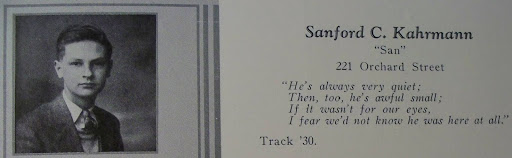
This moment unfolded for me when I took the package from my mailbox at 12 noon. Inside was my father’s high school yearbook. Thomas Jefferson High School, class of 1930. Born February 20, 1914, my father graduated high school one year early.

I sit down on the couch and carefully open the package, purchased from an eBay seller a week earlier. I slowly turn the pages, looking closely at each and every face, I am meeting a part of my father’s world heretofore unknown to me. I see wonderful names: Michael Bisco, Walter Bubalis, Louis Charles Chap, Hannibal Gerrundo, Frank Robert Paladino, and Royal S. Cleaves. And then, I turn to page 45, and there, on top, is my father’s beautiful face looking right at me: Sanford C. Kahrmann.

I learn he was a small boy when I read the smiling poetic nugget for my father:

He’s always very quiet;

Then too, he’s awful small

If it wasn’t for our eyes,

I fear we’d not know he was here at all.”

Instantly I am in tears, my body clenched in this moment when he and I are together in a way like never before. My father, the greatest gift life has ever given me. Gone to soon for him, age 55, and for me, age 15. But I know were it not for him, I would not alive today. That is a fact.

My eyes are swollen now. I hold him close, remembering the words my broken 15 year old heart wrote just days after his death on August 16, 1969.

In all times

And in all lives

There are moments filled

With the sincerest intimacy

You and I have shared such moments

And I thank you

And love you

For those times

And today, Daddy, we shared another one. I am always, now, forever and beyond, your son loving you.

****************************

You Call Us Disabled…

How can you say your helping human beings if you don’t think of them as human beings?

My name is Luther Willis and before I get goin’ here I just want to thank Mr. Peter Kahrmann for lettin’ me write this here piece in his blog.

We talked some and I said what I had to say and he smiled and said, “Have it it then,” and I’m damn glad he did ‘cause you might know he has this here bullet in his head and him goin’ off has different meanings, one’ve’m bein’ mighty messy.

Anyway, he said I could have it,  so I’m gonna do just that.

I live with what most folks call a disability but the specifics of it are of no never mind here. The thing is, lots of people call us disabled when most of those doin’ the callin’ are  bad disabled. I mean to say I can’t think of a disability much worse than a mind that can’t see a person’s humanity ‘cause maybe they have a brain injury, or can’t see or can’t walk, things like that. What’s worse is I see and seen people in powerful places makin’ all kindsa decisions about people they don’t see as human.

Might as well be slave owners

How can you say your helping human beings if you don’t think of them as human beings? Seems impossible. And people inflictin’ rules and regulations on the lives of people they don’t know are people. Might as well be slave owners, ‘cause there ain’t much of a difference.

Now I don’t ‘spect New York’s a helluva lot different than other places, though it would be mighty nice if it was. Here in New York you got a health department that has an advisory board it ‘spose to listen to about people livin’ with brain injuries and it does everything with that there advisory board but listen to’em. Then you got a state agency ‘spose to work with this here Independent Living Council and some times you got to wonder if what spills outta that agency ain’t just plain back stabbing schoolyard shit.

Anyway, maybe if people realized all people are people, things might just get better, for all of us. Now what’s so bad about that??

Thanks for readin’ my words.

Yours Truly,

Luther Willis

_____________________